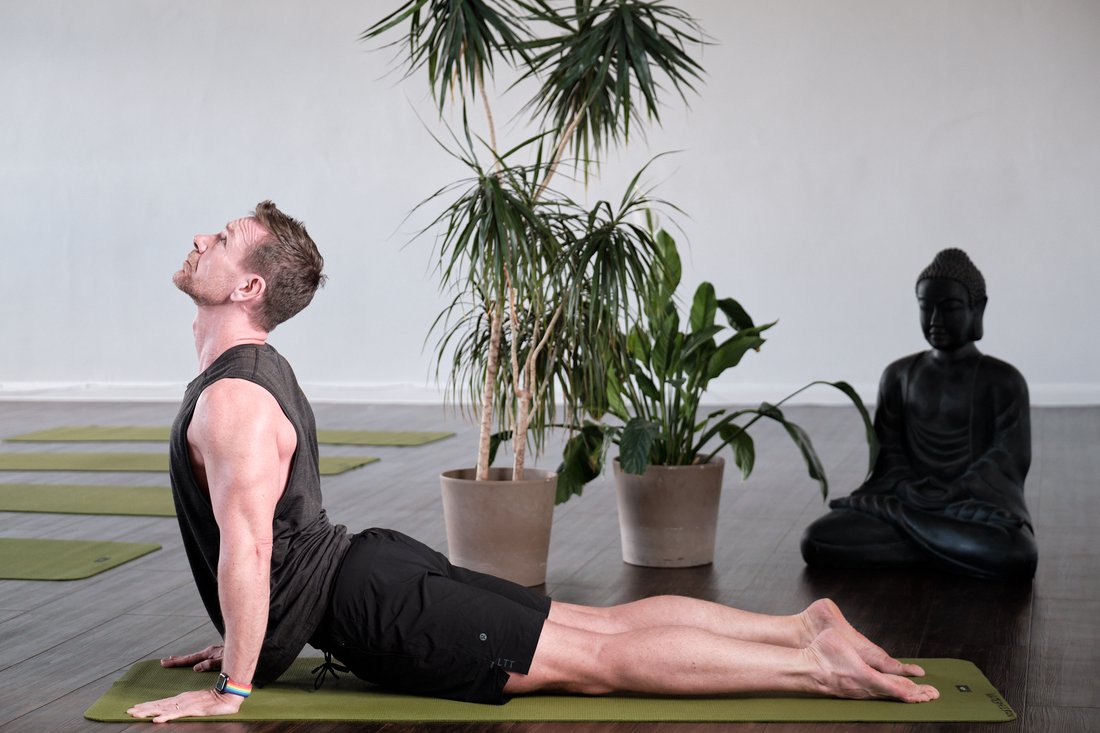
Learn and practise Ashtanga yoga in the traditional Mysore style. Taught by David Keens. Everyone welcome, from complete beginners to long-time practitioners.
Ashtanga is a moving, breathing, flowing style of yoga practice. You learn a structured sequence of yoga postures and movements, one at a time, at your own pace.
Assisted self-practice is the traditional way Ashtanga is taught, even to beginners. It’s often called Mysore-style, after the city in southern India where Ashtanga Vinyasa yoga began in the form it’s practised today. Everyone in the room practises their own sequence, at their own pace, and I teach each person individually. You don’t need to know the sequence to start. You’ll learn it posture by posture, and your practice will grow week by week. The practice becomes your own.


Bushido Studio, 3 Radcliffe Street, Wolverton, Milton Keynes MK12 5DQ (map)
There’s on-street parking on the square right outside, and Wolverton station is about a ten-minute walk away. Inside there’s somewhere to leave shoes and bags, space to make a drink, and a gender-neutral toilet.
Mysore-style assisted self-practice doors open at 6:30am. Arrive any time, but finish your practice by 9:15am. A self-practice usually takes somewhere between 60 and 90 minutes.
New to Ashtanga? Any Sunday is a good first morning. Come between 7am and 7:30am. I’ll show you where to put your mat and start you with a first sequence to learn. Expect around an hour on your mat at your first practice. You can take breaks whenever you need. The common questions below cover what happens when you arrive and what to bring.
Already have a practice? Come whenever suits you, and do your Ashtanga practice. Tell me where you’re up to, and we can work out how best to develop your practice together.
On the first Sunday of each month, starting at 8am, you can join a counted practice: 75 minutes of the Primary series (the first sequence in Ashtanga), practising together to my count of each movement and breath. Self-practice carries on alongside it. If you’re doing your own practice, keep going at your own pace through the count, or join in.
No booking necessary. Just turn up.
£10 or £5 a practice. Choose at the self-service payment card reader.
Payment is a contactless tap at the door. No cash, no complex class passes that expire, no advance payments or booking necessary.
I also teach one-to-one, at Bushido Studio in Wolverton or at my home studio in Middleton, Milton Keynes, available on request. These sessions work well for focused technical work, for building a self-practice from scratch, or if Sunday mornings don’t fit. Get in touch to arrange.
It can look a little chaotic at first. Someone might be in a headstand next to someone in a forward bend, next to someone just sitting quietly, and everyone seems to know what to do. There is a pattern of similar movements and sequences, everyone at their own pace, and with their own variations. It’s quieter than most yoga classes, with no music. The main sound is just everyone breathing and moving. I move around the room helping each person individually.
Come in, leave your shoes by the door, and I’ll say hello. On your first morning there’s a short form to fill in, on the iPad by the door or on paper. Then tap your card to pay and roll out your mat. If you don’t have one, there are studio mats to use. I’ll come over and get you started.
I hope not, there’s no reason to. Everyone in the room was a beginner once, and because everyone practises at their own pace, everyone is doing something different anyway. You’ll be taught individually from your first minute, and you’ll find the room a friendly and supportive place to learn.
No. Flexibility is a result of the practice, not a requirement for it. Regular practice builds strength, stamina and steadiness. Flexibility follows in its own time.
No. The practice adapts to any age and level of fitness. If you have a specific health concern, check with a medical practitioner before you start.
Usually, yes. Because everyone practises individually, the practice can be adapted for you. Tell me about anything relevant when you arrive, and always check with a medical practitioner first.
Yes, if you’re 14 or over. Get in touch first and I’ll send you the form to fill in. It has a section at the end for a parent or guardian to sign.
No. Come as you are. There’s a short form to fill in on your first morning, or get in touch and I’ll send it to you beforehand.
It’s early in the morning, and most people don’t eat before practice.
Comfortable clothing, water, a small towel, and a yoga mat if you have one. The studio has some mats, blocks and bolsters to borrow. It’s warm, but bring a layer for the end of your practice.
Bushido Studio is wheelchair-accessible except for the toilet. Ask me if you have any specific accessibility requirements.
On your first morning you’ll learn the beginning of the sequence. Each time you come, once you’re comfortable with what you have, we’ll add the next part. There’s no hurry.
Yes, and it’s one of the strengths of learning this way. Because you learn the sequence yourself rather than following a teacher, you can take it anywhere: at home, at the gym, or at any other Ashtanga studio, where the sequence is the same.
Yes. Moon days are the new and full moons, traditionally observed as rest days in Ashtanga. It’s the choice of each practitioner whether to do their regular practice, a shorter or gentler one, or a restorative practice.

I’m David. I started practising yoga in 2000, and found Ashtanga in 2003 on a six-week beginners’ course. It’s been my practice for over twenty years. I learnt Mysore-style practice at Stillpoint Yoga London from its opening in 2009, and completed my Ashtanga Vinyasa teacher training with John Scott in 2012–13. I’ve been teaching Ashtanga yoga in Milton Keynes ever since, including at Whitespace Studio in Stony Stratford from 2012 to 2026.
I’m also qualified in restorative yoga, having completed Judith Lasater’s ‘Relax & Renew’ training (March 2014), and in Teen Yoga for Mental Health (October 2023).
I teach the traditional counted method, Mysore style: assisted self-practice, with the count, hands-on adjustments, focused technical work, and time for meditation and rest at the end of practice. I see the role of the teacher as creating a space where everyone is supported and guided in discovering their own unique practice of yoga.
For me, part of the joy of Ashtanga yoga is using self-practice to build my own relationship with the sequence and postures, and the counted practice to come together as a group and practise in synchronisation.
I use hands-on adjustments in my teaching, and I’ll always check with you first. It’s your practice, and some days an adjustment isn’t what’s needed.
I’m a registered teacher with Yoga Alliance (E-RYT® 200) and Yoga Pros, and a recognised Level 3 Sports Coach under Sport England. I hold an enhanced DBS certificate with children’s and adults’ barred list checks. I’m fully insured, and my Emergency First Aid at Work certificate runs to November 2028.
Questions before you come? contact@davidkeens.yoga
I usually reply the same day.